Ask a hundred Christians what the sanctuary has to do with their salvation, and most will draw a blank. It sounds like Old Testament furniture — curtains, a table, a lampstand, a box with two carved angels on the lid. Interesting, maybe. Essential? Hardly.
But here is a claim worth testing before you dismiss it: the sanctuary is not a religious antique. It is a blueprint — a working diagram that God handed to Moses, station by station, of exactly how He removes sin from the human race and brings people back to Himself. Paul calls it "a shadow of heavenly things" (Hebrews 8:5). John says he saw the real one, standing in heaven (Revelation 11:19). And if that's true, then the sanctuary isn't a side note to the gospel. It is the floorplan the gospel was built on.
By the end of this article, our hope is that you'll agree it's worth checking out for yourself — because it will change how you read your Bible, how you understand salvation, and how you picture what Jesus Christ is doing on your behalf at this very moment.
"Thy way, O God, is in the sanctuary: who is so great a God as our God?"
What Is "The Sanctuary," Really?
The sanctuary was a portable tent, roughly 55 feet long, that Israel carried through the wilderness and later rebuilt as a permanent temple in Jerusalem. But God did not leave its design to Moses' imagination. He gave exact specifications — dimensions, materials, and the placement of every piece of furniture — and told him plainly:
"According to all that I shew thee... even so shall ye make it... Look that thou make them after their pattern, which was shewed thee in the mount."
That word pattern is the whole key. Moses wasn't inventing a place of worship. He was copying one. And when the work was finished, he checked it against the plan he'd been shown, the way a contractor checks a finished building against its blueprint (Exodus 39:32-43).
A Design Too Specific to Be an Accident
Here's what makes the sanctuary worth a second look: three separate biblical witnesses, writing centuries apart, all point to the same original.
- Moses built the earthly copy "according to the fashion that he had seen" on the mountain (Acts 7:44).
- Paul explains what that pattern was copied from: "the true tabernacle, which the Lord pitched, and not man" (Hebrews 8:2).
- John, writing decades later on the island of Patmos, says he saw the original itself — the golden altar, the ark, the temple of God open in heaven (Revelation 8:3; 11:19).
A blueprint this exact, confirmed by three witnesses across fifteen centuries, is not the kind of thing religions invent by accident. It is the kind of thing you'd expect if God really did want to show humanity, in physical form, exactly how salvation works.
Why the Sanctuary Unlocks the Whole Bible
Once you can see the sanctuary, the rest of Scripture starts reading differently. The Passover lamb, the temple, the priesthood, the torn veil at the crucifixion, the phrase "Lamb of God," Christ described as our "High Priest" who has "passed into the heavens" (Hebrews 4:14) — none of this is separate imagery. It is all one continuous picture, using the same set of symbols from Genesis to Revelation.
That's why the sanctuary has been called, by those who've studied it closely, the foundation of the Christian faith — not a footnote to it. Skip it, and huge sections of both Testaments read like disconnected metaphors. Understand it, and they read like one coherent story, told in the same language throughout.
Why the Sanctuary Unlocks Salvation Itself
Salvation can sound abstract — "accept Jesus," "be forgiven," "be saved." The sanctuary makes it concrete. It shows sin being handled the way you'd expect any real problem to be handled: with a defined process, not a vague feeling.
| Step | What Happens |
|---|---|
| 1. Confession | You bring your guilt honestly to God, holding nothing back. |
| 2. Substitution | An innocent life stands in your place — ultimately, Christ at Calvary. |
| 3. Transfer | Your sin is no longer counted against you; it is placed on Him. |
| 4. Record | Your pardon is granted, and the record of what Christ has done for you is kept. |
| 5. Review | God's justice examines every case, so that His mercy is never careless. |
| 6. Removal | Sin is finally and completely blotted out — not just covered, but gone (Acts 3:19). |
That is not guesswork theology. It is a sequence, and the sanctuary is where you can see every stage of it laid out in physical form — which is exactly why it's worth studying rather than skipping.
Six Articles, Six Functions
Every piece of furniture inside the sanctuary performs one function in that process. See all six at a glance:
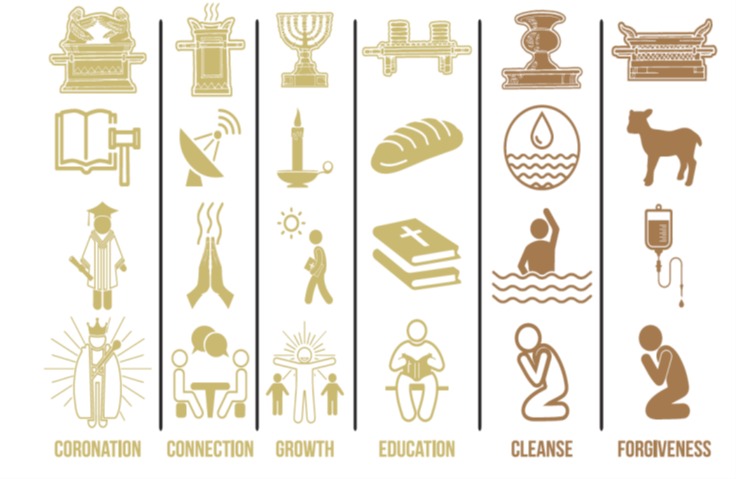
- Altar of Sacrifice — Forgiveness. "Behold the Lamb of God, which taketh away the sin of the world" (John 1:29).
- Laver of Water — Cleanse. Baptism, "the washing of regeneration" (Titus 3:5).
- Table of Shewbread — Education. "I am the bread of life" (John 6:35).
- Golden Candlestick — Growth. "I am the light of the world" (John 8:12).
- Altar of Incense — Connection. Prayer, rising like fragrant smoke (Hebrews 7:25).
- Ark of the Covenant — Coronation. God's law and God's mercy, in the same piece of furniture (Romans 3:25-26).
Why the Sanctuary Shows You What Christ Is Doing Right Now
Here is the part most Christians never get to, because they stop at the cross. The sanctuary had two phases of ministry: a daily service in the Holy Place, and a yearly service in the Most Holy Place. Together they picture two phases of Christ's own work — His death and ongoing intercession since the resurrection, and His present ministry on your behalf right now.
"He is able also to save them to the uttermost that come unto God by him, seeing he ever liveth to make intercession for them."
In other words: Jesus is not finished. He is not a historical figure whose work ended two thousand years ago. Right now, He represents you personally before God — "a Friend at court," touched with the feeling of your struggles (Hebrews 4:15). That is not a metaphor the sanctuary illustrates loosely. It is the sanctuary's entire second half.
Why This Isn't a Strange or Foreign Idea
If elements of this feel familiar to you from your own cultural or religious background — washing before worship, offering sacrifices, presenting food to a god, lighting candles, burning incense — that is not a coincidence, and it is not something to be embarrassed about. Every one of those acts has a station in the sanctuary God gave at the beginning. Cultures didn't invent these ideas independently; they inherited, borrowed, or reshaped fragments of the one original pattern. Our Echoes of the Sanctuary series traces exactly how, culture by culture, article by article.
Why This Matters for You, Personally
The sanctuary is not an impersonal system. The high priest carried the names of Israel's twelve tribes on a breastplate, engraved on stone, worn directly over his heart (Exodus 28:29). Christ carries you the same way.
"Behold, I have graven thee upon the palms of my hands."
God does not process humanity in bulk. Every station in the sanctuary was built to walk one person, at a time, from guilt to full restoration — and that includes you, whoever you are, wherever you're starting from.
If this makes sense to you — if it feels like something worth understanding properly rather than skimming past — that's exactly the response we hoped for. Come study it with us.